
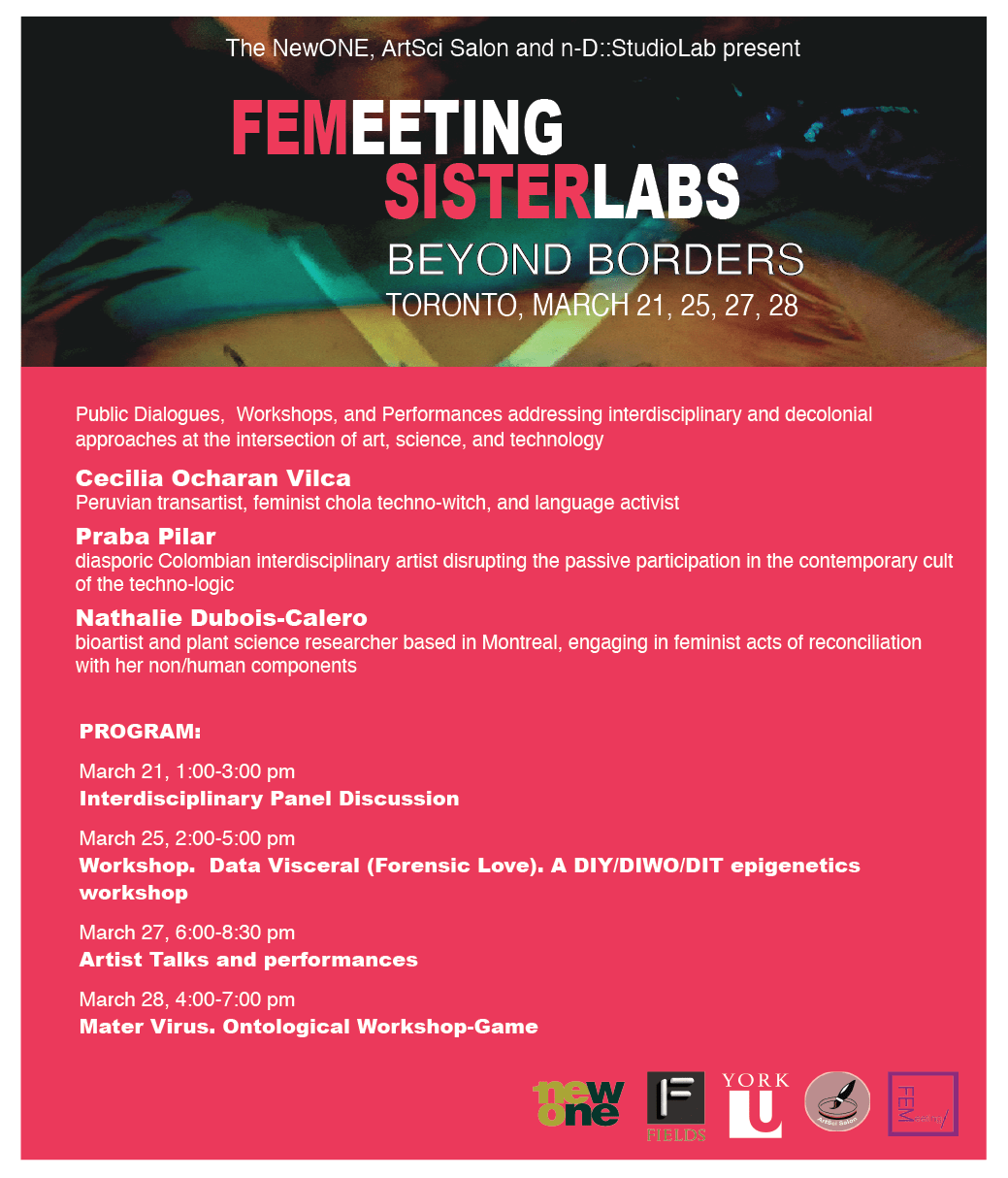

A series of public dialogues, workshops, and performances addressing interdisciplinary and decolonial approaches at the intersection between art, science, and technology
featuring:
Cecillia Ochalan Vilca — Peruvian transartist, feminist chola techno-witch, and language activist;
Praba Pilar — diasporic Colombian interdisciplinary artist disrupting the overwhelmingly passive participation in the contemporary cult of the techno-logic;
Nathalie Dubois — bioartist and plant science researcher based in Montreal, engaging in feminist acts of reconciliation with her non/human components.
This program is the culmination of a term-long pedagogical effort to foster, connect, and consolidate interdisciplinary dialogues across the 5 courses at the NewONE Program (New College, University of Toronto). It is also part of a short-term mobile residency, based on the sustainable principles of sharing knowledge and resources, and the goal to foster interdisciplinary dialogues and new pedagogy across 4 institutions in Canada and in the US. Finally, the initiative is part of the FEMeeting SisterLabs series designed to support and lead to the FEMeeting, a women and women-identified conference taking place on June 23-28 2024 at the University of Windsor.
Events will take place at various locations in Toronto. Details can be found at https://artscisalon.com or at https://www.newcollege.utoronto.ca/new-one-news-and-events/
Public Program
March 21, 1:00-3:00 pm
SisterLab #1
Panel Discussion Interdisciplinary and decolonial practices in art, science and technology
Cecilia Vilca Ocharan Transartist, Lima, Perú
Praba Pilar, Interdisciplinary Artist, US/Colombia
Nathalie Dubois-Calero, Bioartist and Plant Scientist, Montreal
Melanie Jeffrey, Indigenous Studies and Human Biology, University of Toronto
March 25, 2:00-5:00 pm
Workshop #1 Data Visceral (Forensic Love)
A DIY/DIWO/DIT epigenetics workshop
By Cecilia Vilca Ocharan Description: In this workshop, participants will hack personal data (imaging tests, biochemical analysis, pathological studies, chromatography research, neurological exams, etc.) to extract and reappropriate “visceral” data, that is data as undervalued sensitive knowledge: history and personal (internal/external) territory, instinct, non-linear times, and the different scales we inhabit. Visceral data is the chronicle of our own bodies.
March 27, 6:00-8:30 pm
SisterLab #2 Artist Talks and performances
Cecilia Vilca Ocharan
Praba Pilar
BacterHuman.
A performance and talk by Nathalie Dubois Calero
March 28, 4:00-7:00 pm
Workshop #2 Mater Virus
Ontological Workshop-Game for Post-Pandemic Reconciliation by Cecilia Vilca Ocharan and Nathalie Dubois-Calero
Description: Mater Virus (Mother virus) is an ontological workshop-game where the public finds their more intimate specificities – baldness, communication ability, and disease susceptibilities – what makes us unique is being an inheritance from viruses at a different time in our history. Participants will not only learn about sequencing, SNPs, retroviruses, and evolution, but they will also “be ” viruses and be conscious that our body is also territory and identity. They will connect to the performativity of biology. The information is brought to bodies to generate reflection through play, acquiring knowledge, and scientific awareness.
About the artists
Cecilia Vilca https://ceciliavilca.com/ is a Peruvian media artist whose artistic work at the intersection of art and science applies a decolonial lens to gender, society, and nature by connecting ancient technologies with new ones. Her main goal and poetic is to encourage reflection through revelation using technology. Her projects are born from her personal crusades; therefore, they are micropolitical flesh.
Prada Pilar https://www.prabapilar.com/ is a diasporic Colombian interdisciplinary artist. The two artists will come to Toronto with their individual practices and their present collaboration on the “Techno Tamaladas” project, which draws on the practice & knowledge of cultivating corn/maíz across the Americas to sustain life. In recognizing the Indigenous technology of nixtamalization as a technology of life, the project reimagines technological futurity.
Nathalie Dubois-Calero https://www.nathalieduboiscalero.com/ is a “fully self-accepted BacterVirHuman”, a bioartist and plant science researcher based in Montreal. her works are feminist acts of reconciliation with her non (or too much?) human components. She uses microbes as her main medium in workshops, performances, videos, and object-making. Her recent project, BacterHuman, focuses on the cutaneous microbiota (all the microorganisms living on and inside the skin) and the multifaceted relationships we have with it.
Melanie Jeffrey is a settler of mixed Scottish English and Irish descent. She is a bridge-builder between Indigenous and western understandings of STEM. She enjoys learning with community partners and students in reciprocal relationships. Her research focus is on land stewardship and hematological and environmental engineering approaches to assessing the effects of industrial carcinogens in air, soil and water on atypical leukaemia oncogenesis in First Nations communities in Ontario.
This initiative has been possible thanks to the support of New College and is a collaboration with the Fields Institute for Research in Mathematical Sciences and York University’s Computational Arts Program. On Apr 2, the artists will travel to engage with two partner programs: the Coalesce Lab at the University at Buffalo and the Nature Lab at the in Troy.
 FEMeeting
Leave a comment